






The Kinetic Ballet: A Deep Analysis of Spatial Geometry and Momentum in Apex Legends

Since its surprise launch in 2019, Apex Legends has distinguished itself within the battle royale genre not merely through its character-driven narrative or "Ping" system, but through a sophisticated physics engine that prioritizes kinetic momentum. While other shooters focus on the "gun up" experience, Apex operates on the principle of the "body in motion." This article explores the deep mechanical architecture of the game’s movement systems, analyzing how spatial geometry and the Source Engine’s legacy have created a unique competitive language that transcends simple aiming and shooting.
1. The Source Engine Legacy: Modified Physics and Air Strafe Logic
The foundation of Apex Legends’ movement lies in its DNA—a heavily modified version of Valve’s Source Engine. This engine is historically significant for its unique handling of air acceleration, a vestige of Quake physics. In Apex, this manifests as "Air Strafing," a mechanic where a player can manipulate their trajectory mid-air by combining directional inputs with smooth mouse movements. Unlike modern engines that treat a jumping player as a ballistic projectile with a fixed arc, Apex allows the player to "fight" gravity through tangential velocity.
This technical quirk transforms every jump into a tactical decision. By understanding the math behind air acceleration—calculated through the dot product of the player's velocity and their input vector—high-level players can navigate around corners without ever touching the ground. This isn't just a visual flourish; it is a fundamental circumvention of the game's intended spatial limitations, allowing for "tap-strafing" that forces the engine to recalculate momentum instantaneously.
2. Sliding and the Friction-Coefficient Threshold
Apex Legends introduced the "Slide Jump" as the universal heartbeat of its gameplay loop. The game’s physics engine applies a friction-coefficient to the player model based on their current stance. When a player initiates a slide, the friction is drastically reduced, allowing the character to carry forward velocity for a specific window before deceleration kicks in. This creates a rhythmic "on-off" toggle for speed that players must master to maintain a high average velocity across varied terrain.
The Physics of Friction
- Dead-Sliding: Occurs when a player attempts to slide before the internal cooldown (roughly 2 seconds) has reset, resulting in a sudden friction spike.
- Momentum Shifting: The transition from a sprint into a slide-jump that resets the "grounded" state, allowing for a burst of speed.
- Terrain Interaction: The engine rewards downward slopes by virtually eliminating friction, turning the environment into a series of natural accelerators.
3. The Geometry of Wall Bouncing and Normal Vectors
Wall bouncing is perhaps the most elegant intersection of geometry and physics in Apex. When a player makes contact with a vertical surface mid-jump, the game checks for a "climb" input. By purposefully avoiding that input and jumping at the precise frame of contact, the player interacts with the surface's "normal vector"—the perpendicular line extending from the wall. The engine then reflects the player's momentum away from the wall with minimal loss in energy.
This interaction is a pure exercise in spatial geometry. A player must calculate their angle of approach relative to the wall’s normal to determine the exit trajectory. It effectively turns static geometry into a trampoline, allowing for unpredictable redirections that break the visual tracking of an opponent. It is a defense mechanism that uses the map itself as a shield, converting a dead-end wall into a tool for repositioning.
4. Zip-line Hyper-Jumping and Vertical Momentum

Zip-lines in Apex are not merely transit lines; they are high-velocity physics objects. By interacting with a zip-line and jumping nearly simultaneously (specifically within a 1-to-2 frame window), players can perform a "Super Jump." This technique exploits the engine’s tendency to stack the zip-line’s upward pull with the player’s manual jump force, resulting in a vertical leap that is significantly higher than a standard jump.
Zip-line Techniques
- Vertical Zip-line Dancing: Rapidly attaching and detaching to reset the "interact" cooldown while gaining height.
- Horizontal Super-Jumping: Using the zip-line's anchor point to launch into a slide-jump.
- Mantle-Jumping: A complex combination of zip-line interaction and ledge-climbing physics that yields the highest possible vertical boost in the game.
5. The Octane Stim and Speed-Strafing Dynamics
Octane’s "Stim" provides a 35% to 40% increase in movement speed, but its true power lies in how it interacts with "strafe-speed" while aiming down sights (ADS). Every weapon in Apex has a specific ADS movement multiplier. When combined with the Stim, Octane can reach a strafe velocity that exceeds the tracking speed of many optics. This creates a "lag compensation" nightmare for opponents, where the Octane player moves faster than the network can updates their hitbox.
This represents the "aggression" phase of Apex's kinetic evolution. Speed isn't just for travel; it is a defensive layer. By moving faster than the average human reaction time (roughly 200ms-250ms) can track, Octane players use velocity to "dodge" bullets through raw positioning rather than cover. The math here is simple: if the player's lateral velocity is higher than the opponent's crosshair tracking capability, the player is effectively invincible.
6. Horizon and the Mastery of Aerial Friction
Horizon’s passive ability, "Spacewalk," is a direct manipulation of the engine's air-control variables. Most legends suffer from a "stagger" effect when falling from heights, which momentarily sets their friction to maximum. Horizon ignores this, allowing for seamless transitions from 100-foot drops into high-speed slides. Furthermore, her ability to turn sharply mid-air without losing momentum breaks the standard air-strafe logic that governs other legends.
Spatial Advantage of Spacewalk:
- Vector Retention: Maintaining 100% of horizontal speed after a vertical drop.
- Gravity Lift Synergy: Using the lift to gain height and then air-strafing in a 360-degree radius to scout.
- Fall-Shock Cancellation: Eliminating the landing animation to maintain offensive pressure.
7. Pathfinders Grapple: The Calculus of Arc Velocity
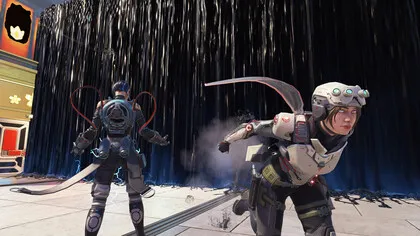
Pathfinder’s grapple is the most complex physics tool in the game. It functions on the principle of "Pendulum Physics," where the grapple point serves as a pivot. The player's velocity is calculated based on their distance from the pivot and their look-angle. By looking away from the grapple point at a specific angle (usually 45 to 90 degrees), players can increase the "tension" in the virtual tether, resulting in a massive acceleration boost known as a "Slingshot."
This requires an intuitive understanding of calculus and centripetal force. The player must balance their centripetal acceleration (pulling them toward the point) with their tangential velocity (moving them past it). If done correctly, the result is a trajectory that covers hundreds of meters in seconds. It is a masterclass in how a single mechanical tool can redefine the "geometry of the arena," turning any overhead light pole or cliff edge into a potential launchpad.
8. Mantle Shifting and the Ledge Interaction Layer
The "Mantle" is the animation that triggers when a player reaches the top of a wall. In Slay the Spire or other static games, this would be a fixed animation. In Apex, the mantle is a "physics state" that can be canceled or redirected. By inputting a crouch or jump at the peak of the mantle, players can perform a "Mantle Jump" or "Crouch Slide" off the top of the ledge. This preserves the upward momentum of the climb and converts it into horizontal speed.
This is critical for "High-Ground Dominance." Instead of slowly climbing a wall and being vulnerable at the top, a player can "Shift" through the mantle to arrive on the roof at full sprint. It turns the most vulnerable moment of a climb—the transition over the lip—into the most dangerous moment for the defender. It is a manipulation of "animation frames" to maintain kinetic flow.
9. The Impact of Tick-Rate on Kinetic Precision
The technical reality of Apex’s 20Hz servers creates a friction point with its high-speed movement. Because the server only updates the game state every 50 milliseconds, movement that occurs between those "ticks" must be interpolated. This leads to the phenomenon of "Super-gliding"—a frame-perfect technique where a player jumps and crouches within one frame of finishing a mantle.
At 144Hz, a single frame is roughly 6.9 milliseconds. Executing a move within that window is a feat of human-machine synchronicity. Because the server can't perfectly track a super-glide, the player model often "teleports" forward at an impossible speed. This is where the game’s physics engine meets its hardware limits, creating a high-tier skill gap that is defined by "frame-perfect execution" rather than just strategic positioning.
10. The Future of Apex: Kinetic Intelligence as a Skill Floor
As the Apex Legends community matures, the "Kinetic Intelligence" required to play at a high level continues to rise. Movement is no longer a secondary skill; it is the primary method of interaction. The game has evolved from a shooter with movement into a movement-sim with shooting. This shift ensures that the "Spire of Skill" in Apex remains one of the highest in the gaming world, as players continue to find new ways to break and rebuild the physics of the Source Engine.
The legacy of Apex will not be its loot or its characters, but how it taught an entire generation of players to think in terms of vectors, momentum, and spatial geometry. It is a game that rewards the bold and the fast, proving that in the world of the Frontier, the only true sin is standing still.
In conclusion, Apex Legends represents a peak in competitive physics-based design. By leveraging the quirks of a modified Source Engine, Respawn Entertainment created a game where movement is as expressive as any card in a deckbuilder or any character in an RPG. Through wall-bouncing, tap-strafing, and pendulum-swinging, players have turned the maps of Apex into a vast, kinetic playground, ensuring that the "ballet of bullets" continues to evolve for years to come.